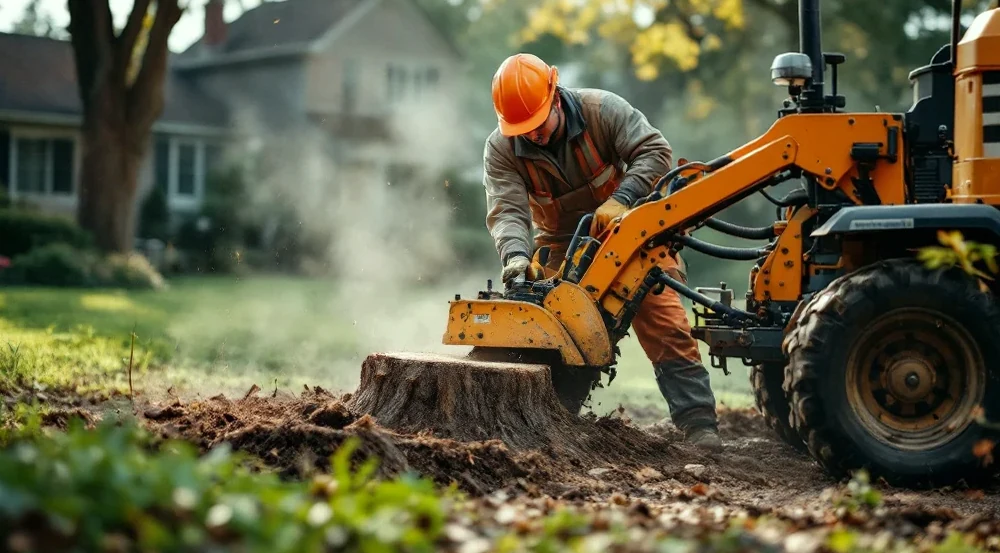
How does stump grinding work?
Stump grinding uses a machine with a spinning, toothed wheel to chew the stump and upper roots into wood chips, usually down to 6 to 12 inches below grade. It's not the same as stump removal, which pulls the whole root ball out. Grinding leaves the hole filled with chips and soil, ready for grass or planting.
The grinder is a heavy piece of equipment, often self-propelled or towed behind a truck. The cutting wheel is hydraulically powered and moves side to side across the stump, biting into the wood in small passes. As the wheel spins, it throws chips into a pile or into a bucket, depending on the machine. The operator controls the depth and width from a handle, and can adjust the cut to go deeper or wider as needed.
What separates a good grind from a sloppy one is how far below grade the machine goes. A shallow grind leaves a raised mound that settles and sinks over time, which is a trip hazard and looks bad. We aim for at least 8 inches down, and often more for larger stumps, so the surface can be smoothed over and seeded. The chips left behind are a bonus: they break down into decent mulch for flower beds or a compost pile.
One thing you won't get with grinding is a hole you can plant a tree in right away. The roots and wood are gone, but the soil is a mix of chips and clay. If you want to plant something new, you'll need to add topsoil and let the area settle for a season. That's a normal part of the process, not a sign the job was done wrong.
- Grinding depth: typically 6 to 12 inches below grade
- Chips can be left as mulch or hauled away
- No huge hole left behind, just a smooth, level area
- Roots near the surface are also ground out, which helps prevent new shoots
Short version
- A grinder chews the stump and upper roots into chips.
- It goes below grade, so the area is level and ready for topsoil.
- It's faster and cheaper than full stump removal.
- Chips are yours to keep or we can haul them off.
What to expect, start to finish
From your first call to the final cleanup, stump grinding is a straightforward process. We give same-day estimates over the phone, show up at the scheduled time, grind the stump below grade, and clean up the chips. You'll know exactly what's included before we start.
It starts with a phone call. We ask about the stump's size, location, and access, and we can usually give you a price on the spot. Same-day estimates are given with phone calls. (brentsstumpgrinding.com) That means no waiting days for someone to drive by and measure. If the stump is in a tight spot or there's something unusual, we'll tell you and may need to see it in person, but that's rare.
On the day of the job, our crew arrives with the grinder. We'll walk the area, check for buried lines, sprinkler heads, or landscaping you want to protect. Then we get to work. The grinder is loud, so you'll want to keep pets and kids inside for the duration. Most residential stumps take 30 to 60 minutes of grinding time, but the whole visit, including setup and cleanup, runs about an hour.
After the grind, we rake up the loose chips, level the area, and if you want, haul the chips away. Some outfits just blow the chips into the yard and call it done. We leave the site clean, with the hole filled and the surface ready for seed or sod. If you plan to use the chips as mulch, we'll leave them in a pile where you want them.
The only thing you need to do beforehand is mark any underground utilities if you have them, and clear the area around the stump of rocks or debris. We'll handle the rest. If the stump is near a driveway or sidewalk, we'll take care not to damage the concrete, but you should know that grinding can leave a small divot in the soil next to hard surfaces, which is normal.
- Call for an estimate.We give same-day pricing over the phone based on size and access. No waiting for a site visit.
- We schedule a time.Most jobs are done within a few days. We'll confirm the date and time with you.
- Our crew arrives.We set up the grinder, check for obstacles, and get to work. You'll hear it, but it's not a long process.
- Grinding and cleanup.We grind below grade, rake up chips, and level the area. If you want the chips gone, we haul them.
How long does stump grinding take?
Most residential stumps take 30 to 60 minutes of grinding time. The whole visit, including setup, grinding, and cleanup, usually runs about an hour. Larger stumps or tough access can stretch that, but it's still a one-visit job for nearly every home.
The size of the stump is the biggest factor. A small stump, say 12 inches across, can be done in 15 minutes. A large one, 30 inches or more, might take an hour. The grinder has to make multiple passes, and the operator has to keep the wheel at the right depth. Hardwood stumps like oak or hickory are denser and take longer than pine or sweetgum.
Access matters. If the stump is in the middle of a backyard with a narrow gate, the crew may have to maneuver a smaller machine or use a remote-controlled grinder. That adds setup time but doesn't change the grinding itself. If the stump is close to a house or fence, we work more carefully, which can slow things down a bit.
One thing that can stretch the job is roots. If the stump has large surface roots, we'll grind them out as well, which adds time. But that's part of doing the job right. You don't want a root left that pushes up a new sprout or catches your mower deck.
In short, you're not looking at a half-day project. Plan for an hour of noise and activity, and then the area is done. That's a fraction of the time it would take to dig the stump out by hand or with a shovel.
- Small stump (under 20 inches): 15 to 30 minutes
- Medium stump (20 to 30 inches): 30 to 45 minutes
- Large stump (over 30 inches): 45 to 60 minutes
- Add 15 to 20 minutes for cleanup and leveling
Setup (10-15 minutes)
Position the grinder, check the area, and make sure the machine is ready.
Grinding (15-60 minutes)
This is the main event. The time depends on stump size and wood type.
Cleanup (10-15 minutes)
Rake chips, level the ground, and load the truck if we're hauling away.
Frequently Asked Questions
How much does stump grinding cost in Huntsville?
Most residential stumps run $100 to $350, depending on diameter and access. (dixielandtree.com) Small stumps start around $100, medium ones around $200, and large ones $350 or more. (dixielandtree.com) The only way to get an exact figure is a quick phone call for a same-day estimate.
Do you grind below ground level?
Yes, we grind down 6 to 12 inches below grade, depending on the stump and soil. That leaves a level area you can cover with topsoil and grass seed. If you want to plant a tree in the same spot, you'll need to add fresh soil and let the area settle.
What do you do with the wood chips?
We can leave them in a pile for you to use as mulch, or we can haul them away for a small fee. Many homeowners use the chips in flower beds or compost. If you don't want them, we'll take them with us.
Will the grinding damage my lawn or driveway?
The grinder is heavy, so it can leave slight ruts in soft ground, but we take care to minimize that. We avoid concrete and asphalt, and we'll rake and level the area when we're done. If the stump is right next to a sidewalk, there may be a small gap where the roots were, but that's normal.
How do I know if a stump has to be ground vs. removed?
Grinding is the right choice for most homeowners because it's faster and cheaper. Stump removal, which pulls the entire root ball out, is only necessary if you need to build a foundation or plant a tree in the exact same spot. For everything else, grinding is sufficient.
Can you grind a stump that's close to my house or fence?
Yes, but we'll work more carefully and may use a smaller grinder. The machine can get within inches of a structure, but we'll take precautions to avoid damage. Let us know about tight spots when you call, and we'll factor that into the estimate.
Do I need to be home during the grinding?
You don't have to be, but we need access to the stump and a place to park the truck. If you're not going to be there, just let us know and we'll work around your schedule. We'll also need to know about any underground lines or sprinkler heads.
What happens to the hole after grinding?
We fill it with the chips and soil that come out of the grind, then level it. Over the next few months, the chips decompose and the soil settles, so you may need to add a bit of topsoil. That's normal, and it's why we recommend waiting a season before planting anything heavy.
How soon can you come out?
We usually schedule within a few days of your call. In the busy season, it might be a week or so, but we'll give you a clear timeframe when you call for the estimate. Same-day estimates are always available over the phone.
Is stump grinding loud?
It's loud, comparable to a chainsaw or a lawn mower. We recommend keeping pets and kids inside while we work. The noise lasts 30 to 60 minutes for a typical stump, so it's not a long disruption.
Sources
Need stump grinding in Huntsville? Get a free estimate today.
📞 256-946-4625