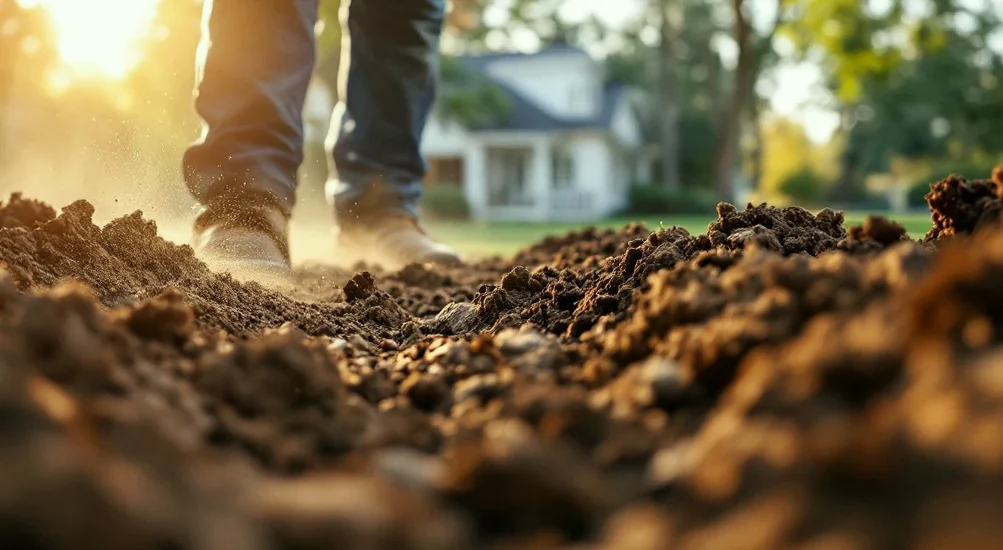
What is Yard Leveling & Grading and how does it work?
Yard leveling and grading is the process of reshaping the ground around your home so water drains away from the foundation and the surface is smooth and usable. It involves cutting, filling, and compacting soil to create the right slope.
Think of your yard as a shallow bowl. If the bowl tilts toward your house, every rainstorm sends water straight at your foundation. Grading fixes the tilt. We cut down the high spots, bring in clean fill for the low spots, and compact it so the whole yard slopes away from the structure at a steady rate, usually about 1 inch per foot for the first 6 to 10 feet.
Leveling is a lighter touch. It smooths out dips and humps so the lawn is even, which matters if you mow, play on it, or just want to walk without tripping. Grading is the bigger job; leveling is the finish work. On a typical lot, we do both in one pass.
The work starts with an assessment. We walk the property, check how water moves after a rain, and look at the foundation line. Then we mark the high and low spots. The reshaping can be done by hand for small areas, but most jobs need a skid steer or a box blade on a tractor. For tight spots behind a house, a crew with shovels and rakes might be the only option.
The key is the soil. We never just spread topsoil over a low spot and call it done. That settles and leaves you right back where you started. We cut into the existing ground, add fill in thin layers, and compact each one. That's what keeps the grade from shifting after the first big storm.
- Grading reshapes the slope so water moves away from the house.
- Leveling smooths the surface for mowing and everyday use.
- Proper compaction prevents settling and keeps the grade working.
- Your yard drains, not floods.
Short version
- Grading fixes drainage by changing the slope.
- Leveling smooths the surface for practical use.
- Both require cutting, filling, and compacting soil.
- A proper slope moves water away from your foundation.
How Yard Leveling & Grading works, start to finish
The process starts with a site walk to find where water pools and where the foundation is at risk. Then we cut high spots, add and compact fill in low spots, and finish with a smooth, sloped surface ready for sod or seed.
Every job starts with a walkthrough. We look at the gutters, the downspouts, and the way the ground meets the foundation. We check for low spots where water stands after a rain, and we look at the slope of the lot itself. A house at the bottom of a hill needs different work than one on a flat lot.
Next comes the layout. We use a laser level or a transit to mark the high and low points. That gives us a target: the finished grade should drop at least 6 inches over the first 10 feet away from the house. That's the standard for keeping water out of a basement or crawl space.
Then the cutting starts. We strip the grass and topsoil from the high areas. That soil gets moved to the low spots, or hauled off if it's contaminated with construction debris. In Huntsville, we often find bricks, chunks of concrete, and old lumber buried just under the surface from when the house was built. That stuff has to go before we add clean fill.
The fill goes in thin lifts, usually 4 to 6 inches at a time. Each lift gets compacted with a plate compactor or a roller. That's the step that separates a lasting grade from one that settles in the first wet season. After the fill is in, we do a final pass with a rake and a level to check the slope.
The last step is the surface. If you want grass, we can spread topsoil and seed, or lay sod for an instant lawn. If the area is for a patio or a garden bed, we finish it differently. We also make sure the grade ties into your existing drainage, like a French drain or a swale, so the water has somewhere to go.
- Walk the site.We find the low spots, check the foundation line, and see how water moves after a rain.
- Set the grade.Using a laser level, we mark the high and low points and set a target slope of at least 6 inches drop over 10 feet.
- Cut and fill.We strip high areas, remove buried debris, and add clean fill in thin layers to the low spots.
- Compact each lift.Every few inches of fill gets compacted so it won't settle later.
- Finish the surface.We smooth the grade, add topsoil, and seed or sod for a finished look.
Why Yard Leveling & Grading matters for your home
Grading is the first line of defense for your foundation. If water pools against the house, it seeps into the soil, presses on the walls, and can cause cracks, bowing, and mold. Proper grading sends that water away before it becomes a problem.
Your foundation is built to hold up the house, not to hold back water. When the ground slopes toward the foundation, every storm pushes water against the concrete or block. Over time, that water finds tiny cracks and works its way in. In a crawl space, it shows up as dampness and musty smells. In a basement, it's puddles on the floor.
The fix is cheaper than the repair. A typical grading job runs $1,000 to $3,330 for a standard yard. (modernize.com) Compare that to the cost of repairing a foundation, which can run $10,000 or more for major slope adjustments and drainage work. (modernize.com) Spending a few thousand now saves you from writing a much bigger check later.
Grading also protects your landscaping. Low spots turn into mud holes that kill grass and invite mosquitoes. A properly graded yard dries out faster, which means you can use it after a rain. That matters in Huntsville, where afternoon thunderstorms are a summer routine.
There's also the resale angle. A yard that drains well is a selling point. A yard that floods is a red flag. If you ever put your house on the market, a buyer's inspector will notice standing water and sloping ground, and that can kill a deal or knock thousands off the price.
The cost of grading is small compared to the cost of building. New construction in the Huntsville area averages around $170 per square foot for standard homes and $200 per square foot for mid-range builds. (huntsvillebusinessjournal.com) Protecting that investment with a few thousand dollars of grading is a bargain.
Minor dips
Small low spots that hold water for a day after rain. You can wait, but they'll get worse as the soil compacts.
Water near the foundation
If you see puddles within a few feet of the house, or notice musty smells in the crawl space, schedule grading within the next season.
Cracks or bowing walls
If you see foundation cracks or water in the basement, don't wait. Grading is part of the fix, but you may also need drainage work.
Common problems and what causes them
Most grading problems come from poor initial grading during construction, settling soil, or downspouts that dump water too close to the house. Buried debris and tree roots can also create uneven ground that redirects water.
One of the most common issues we see in Huntsville is a house that was built on fill that wasn't compacted properly. The builder scraped the lot, pushed the dirt around, and didn't compact it in layers. A few years later, the ground settles unevenly, and you get a dip right next to the foundation. That's a classic recipe for water intrusion.
Downspouts are another culprit. A downspout that empties right at the foundation dumps a huge volume of water into a small area. Even with good grading, that can overwhelm the soil and cause problems. The fix is simple: extend the downspout at least 6 feet away from the house, or bury a drain pipe that carries the water to a low spot.
Tree roots can also mess up a grade. As roots grow, they push the soil up in some spots and leave voids in others. The result is a bumpy yard that's hard to mow and collects water in the hollows. Grinding the stump and regrading is often the cleanest fix.
Buried construction debris is a Huntsville specialty. When a house is built, the builders often bury scraps of lumber, concrete, and brick in a low spot on the lot. Over time, that debris rots or shifts, and the ground above it sinks. We've pulled everything from old paint cans to a rusted wheelbarrow out of yards.
The solution is to address the cause, not just the symptom. Regrading a yard without fixing the downspout or removing the debris is a temporary fix. The water will find its way back. That's why we always look at the whole drainage picture before we start moving dirt.
Worth it when
- Water pools near the foundation after rain.
- You see cracks in the foundation or drywall.
- You're finishing a basement or crawl space.
- You want a smooth lawn for kids or pets.
Hold off when
- Mostly flat yard, drains fine.
- You just need to fill a few small holes with topsoil.
- You're planning a major landscaping project that will disturb the grade anyway.
Frequently Asked Questions
How much does yard leveling and grading cost in Huntsville?
For a typical residential yard, you can expect to pay between $1,000 and $3,330. (modernize.com) Small projects can come in under $1,000, while large properties or those needing French drains or major slope changes can run $10,000 or more. (modernize.com) The only way to get an exact number is a site visit.
Can I level my yard myself?
For a small dip, you can fill it with topsoil and compact it, but it's hard to get a proper slope by eye. Most homeowners end up with a yard that looks flat but still drains toward the house. A professional crew has the lasers and equipment to get the grade right the first time.
How long does yard grading take?
A typical residential grading job takes one to three days. The time depends on the size of the yard, how much fill needs to be moved, and whether there's buried debris to deal with. We'll give you a timeline when we quote the job.
Will grading fix my wet basement?
Grading is a big part of the fix, but it's not always the whole solution. If water is coming in through the walls or the floor, you may also need a French drain, a sump pump, or foundation waterproofing. We can tell you after we look at the site.
What's the difference between leveling and grading?
Leveling is smoothing the surface so it's even. Grading is changing the slope so water drains a certain way. Leveling is often part of grading, but grading is the bigger job that affects drainage.
Do I need a permit for grading in Huntsville?
Most residential grading that doesn't change the drainage pattern of the lot doesn't need a permit. But if you're doing major earthwork or changing the slope toward a neighbor's property, you might. We handle the permit process if it's needed.
Will grading kill my grass?
Grading will disturb the top layer of soil, so any grass in the work area will be removed. We can reseed or lay sod after we finish, so you end up with a fresh, level lawn. It's a good time to start over if your grass was patchy anyway.
How do I know if my yard has a grading problem?
Walk your yard during a rainstorm and look for where water pools. If you see puddles within 10 feet of the house, or if the soil is constantly damp near the foundation, you have a grading issue. Also check for cracks in the foundation or a musty smell in the crawl space.
Can you grade around an existing tree?
Yes, we can grade around trees, but we have to be careful not to bury the trunk too deep or damage the roots. We'll adjust the grade so water doesn't pool at the base, which can rot the tree. If a tree is dead or dying, we can grind the stump and grade over it.
Sources
Need stump grinding in Huntsville? Get a free estimate today.
📞 256-946-4625