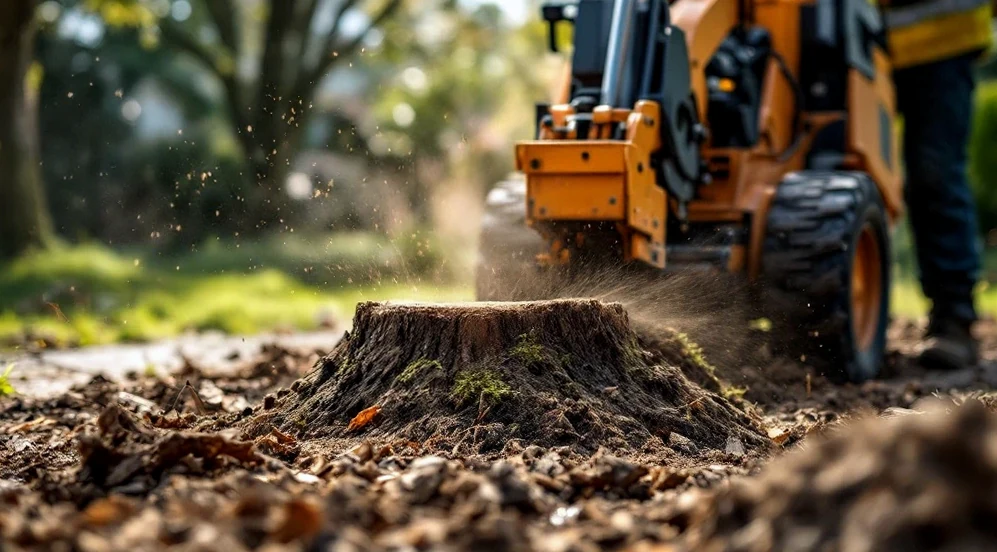
What is stump grinding and how does it work?
Stump grinding is the process of using a rotating cutting wheel to chew a stump down to below ground level. The machine grinds the wood into chips and leaves a hole you can fill with dirt and seed. It's fast, clean, and leaves no stump behind.
When a tree comes down, the stump stays. You can dig it out, but that's a day of shoveling and a big hole. Grinding is different. A stump grinder has a heavy wheel with carbide teeth that spins at high speed. The operator swings it back and forth across the stump, and the teeth chip the wood away layer by layer. The result is a pile of wood chips and a smooth, below-grade surface.
Most residential stumps run $100 to $350, depending on diameter and access. (dixielandtree.com) Small stumps start around $100, medium ones around $200, and large ones around $350. (dixielandtree.com) Some outfits charge a flat rate of $25 to $50 per inch of stump diameter. (dixielandtree.com) We price per stump and per job, and we'll give you a firm number before we start.
The key thing to understand is that grinding removes the stump, not the roots. The main root system stays in the ground and rots over time. That's fine for most yards. If you want to plant a new tree in the same spot, you'll need to deal with the old roots, but for a lawn or a garden bed, grinding is all you need.
- Grinding goes below grade, usually 6 to 12 inches deep, so no stump is visible.
- Chips can be hauled away or left to use as mulch.
- Expect 30 minutes to an hour for a typical stump.
- No chemicals, no burning, no digging by hand.
Short version
- Grinding chews the stump below ground level.
- Costs run $100 to $350 for most stumps. (dixielandtree.com)
- Roots stay in the ground and rot naturally.
- You're left with a hole you can fill with dirt and seed.
How stump grinding works, start to finish
We start by clearing the area around the stump, then we bring in a grinder sized for the job. The operator cuts the stump down in passes, going below grade. We clean up the chips and you're left with a hole ready for soil.
Before we fire up the grinder, we walk the yard. We look for buried lines, sprinkler heads, and anything else that could get in the way. We also check access. A narrow gate or a steep slope can change which machine we bring. That's part of why the price varies by access. (dixielandtree.com)
The grinder itself is a self-propelled unit with a hydraulic arm. The cutting wheel spins at thousands of RPM. The operator lowers it onto the stump and swings it side to side. Each pass takes off a few inches of wood. The teeth are carbide, so they handle dirt, rocks, and nails without dulling fast. We grind down to 6 to 12 inches below the surface, depending on what you plan to do with the spot.
Once the stump is gone, we rake the chips out of the hole. You can keep the chips for mulch, or we can haul them away. The hole gets filled with dirt, and you can seed it or plant something new. The whole thing, for a typical stump, is done in under an hour.
A few things can slow the job down. If the stump is huge, say 30 inches across, that's more passes and more time. If it's near a foundation or a fence, we work slower to avoid damage. If the roots have grown over a walkway, we may need to grind those too. Nothing here changes the process, just the time and the price.
- Site check.We look for buried lines, sprinklers, and obstacles. We also confirm access for the machine.
- Grinding.The cutting wheel chews the stump down in passes, going below grade.
- Cleanup.We rake out the chips, fill the hole with dirt, and leave the area tidy.
Why stump grinding matters for your home
A stump in your yard is more than an eyesore. It's a trip hazard, a magnet for pests, and a spot where grass won't grow. Grinding it out makes the yard usable again and keeps the area safe.
Think about what a stump does to your lawn. You can't mow over it, so the grass around it grows wild. Kids trip on it. Guests stub their toes. It's a constant reminder of the tree that used to be there. Grinding solves all that in one visit.
Stumps also attract pests. Termites, carpenter ants, and beetles love dead wood. A stump is a buffet for them, and they don't stop at the stump. They can move into your house if it's close enough. Grinding removes the food source and cuts the risk.
If you're selling your home, a stump in the front yard is a red flag to buyers. It looks neglected. Removing it is cheap compared to the hit you might take on the sale price. Even if you're staying put, a clean yard is more enjoyable.
There's also the practical side. A stump takes up space you could use for a garden, a fire pit, or just open grass. Grinding frees that space. And if you're tired of mowing around it, you'll appreciate the difference every single week.
Stump is out of the way
If it's in a corner and nobody walks there, you can wait. But the longer it sits, the more it rots and the more pests it attracts.
Stump is near the house or walkway
Termites and ants can travel from the stump to your siding. Grinding it sooner rather than later cuts that risk.
Stump is a trip hazard
If kids or older adults use the yard, that stump is an accident waiting to happen. Grinding it this week is worth it.
Common problems and what causes them
Most problems we see come down to a few things: stumps that are bigger than they look, hidden obstacles underground, and access that's tighter than expected. Each one can add time or cost, but they're all solvable.
A stump that looks small above ground can have a massive root flare below. That's the widening part where the trunk meets the roots. Grinders handle it, but it takes longer. That's part of why we give you a firm price after we see the stump, not a guess over the phone.
Buried obstacles are another one. We've hit sprinkler lines, electrical conduit, and even an old septic tank lid. That's why we walk the yard first. If we hit something unexpected, we stop and figure out the best way around it. It's rare, but it happens.
Access is the third common issue. A stump in a backyard with a 3-foot gate means we bring a smaller machine. That's fine, but it takes longer. A stump on a slope means we need to stabilize the grinder. All of this affects the price, which is why we quote after a site visit.
One thing we hear a lot is, 'Can't you just burn it?' Burning a stump takes hours, and it's illegal in most of Huntsville's city limits. Grinding is faster, cleaner, and doesn't leave a charred mess. We'd rather do it right the first time.
Another question: 'Do I need to remove the roots?' Not usually. If you're planting grass, the roots will rot and the ground will settle. If you're planting a tree, you'll need to work around the old roots, but that's a separate job. For most yards, grinding the stump is enough.
Worth it when
- You want the yard usable again
- You're worried about pests
- You're selling the house
- You're tired of mowing around it
Hold off when
- A spot you never use
- You plan to excavate the area anyway
- You're okay with it rotting naturally
Sources
Need stump grinding in Huntsville? Get a free estimate today.
📞 256-946-4625